Idea Backlog
So I thought I’d add a backlog-of-ideas-post, which I’ll update from time to time, to drop stuff off. If someone wants it, feel free to take it, it’s things I want to get rid of. Nothing here is very interesting, so yeah.
Calendar Blocking Startup
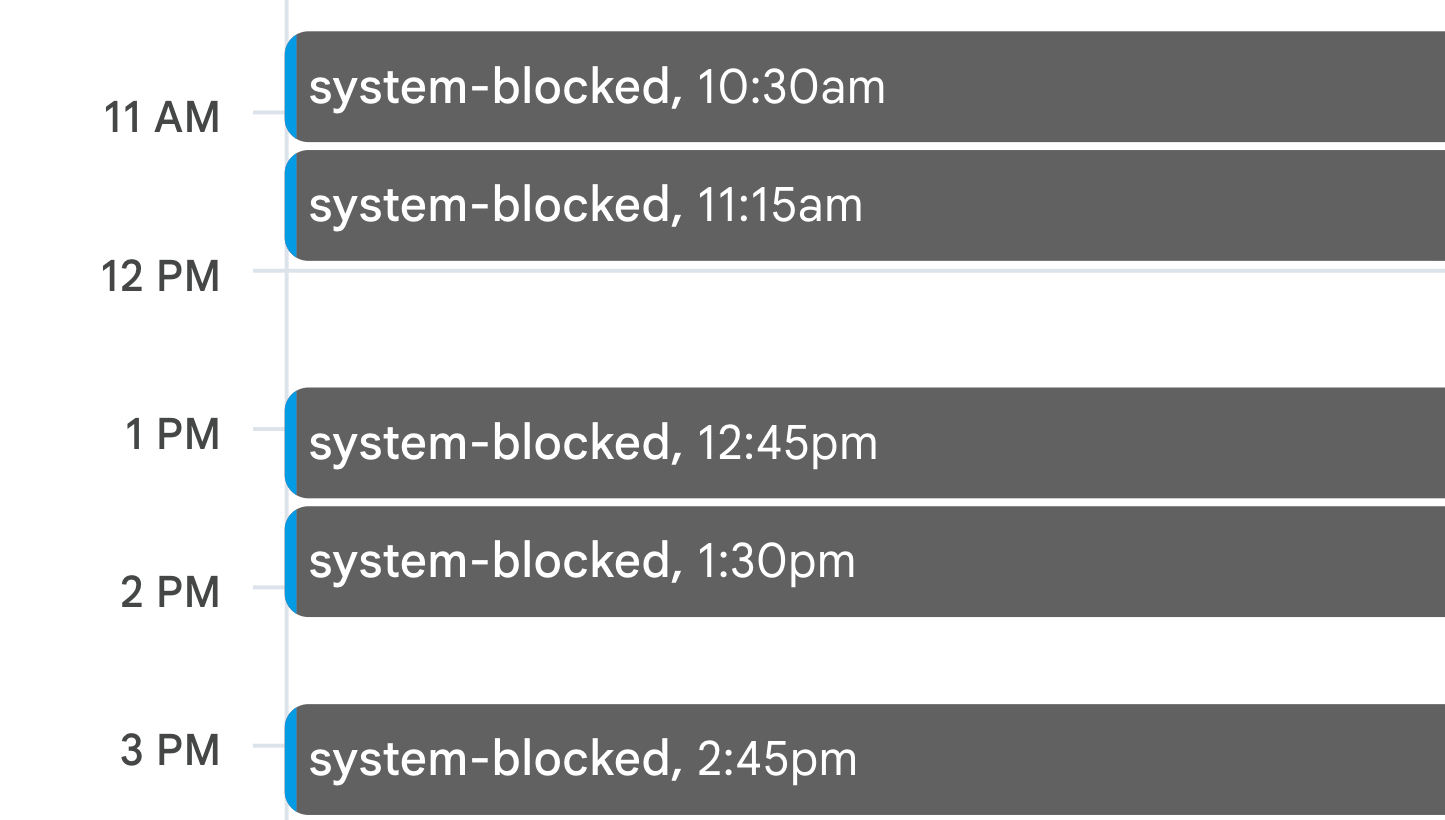
Basically a small script that sets up fake blocker-events in a connected calendar. When a real calendar event is added, one of the blockers is removed automatically. The idea is to appear very busy but just not fully booked yet.
This is mostly for calendars visible to clients, prospective clients or anything like that (using something like Calendly). The idea is that people will think more highly of you and are more likely to book a meeting with you (this is assuming you want that muhahahaha) when you appear to be in demand.
This was from a couple years ago but back then a simple test showed about 10-15% more bookings when appearing super-busy vs when not, with the same amount of visits (so it increases the conversion rate from somebody viewing your calendar page to a booked call, substantially so).
It’s may be just sketchy enough that Google/Microsoft (who run people’s calendar) won’t do it themselves while also being compliant with everything at the end of the day, you are totally allowed to create blocker events in calendars if their owners want you to, no law or terms of service stopping you (not legal advice).
It sounds fairly small but it got complicated pretty quick back then (this was without AI coding tools).
I wouldn’t underestimate the economics either, a lot of the worlds interactions are calendar bookings (b2b sales ofc but also say, dentists etc) and a part of a lot of jobs probably is to appear somewhat busy / in demand (think professors, realtors etc)
Tofu produced with plant cruelty
So a lot of vegetarian/vegan products is very much responsibly-produced/organic/fair-trade etc etc pp
I think for the marginal meat eater, the fucked-up-ness of eating what was once an animal that was walking around, grazing, wanted to have kids etc is actually a bit part of the appeal, actually? Like, you are “weak” if you can’t “stomach” (sry) that?
It doesn’t make sense logically speaking, of course, but it might feel that way, a bit, for some people?
Like, personally, I just don’t see myself as a vegan/vegetarian even though I agree it makes sense? So I sometimes eat a little bit of meat, just to kind of prove I can do it, sort of, not verbally expressing that part.
So maybe maybe maybe maybe there is room in the market for fucked-up tofu. Like, emphasize how much cruelty was involved in producing it, that the soy beans were beaten every day, that you did all kinds of fucked things to grow them etc pp. Basically try to make meat-production look relatively nice in comparison to what you have been doing to the soy beans / the other ingredients of your product.
There is an opportunity to get creative there. When you see time-lapse-videos of plants, they look just like animals and that could be used. Plants are really smart, like they can search for food, communicate, defend themselves etc etc! They are just, like, slow.
There are also no laws stopping you, there is no such thing as “plant rights”. And if you want to protect animals, maybe torturing plants sort of set an anchor, like “if doing that to a plant feels wrong, maybe it is even more wrong towards an animal” (maybe backfires if it gets tooo good^^).
Like, not sure about it, but really all the products are branded as less-fucked-up-than-meat and not more-fucked-up-than-meat, so maybe there is an opportunity there. maybe.
Books where you need to find the mistakes
Not so simple to develop but basically a real physical text book (so more a learning-book about a subject, not a novel) which contains some intentional mistakes. It has two sliders, one on its x- and one on its y-axis. When you move the sliders to the position of the text where there is a mistake and press a button, you get a reward (such as a gummy bear dropping out of the book from a hidden compartment).
It would need to track which page you are on, not easy, maybe a little bit of electrical resistance on a part of each page or an led on one side and a photodiode on another but not sure.
The idea is that we all like to find people’s mistakes and point them out and it could be used for learning. Catching something that sounds plausible but is actually wrong is maybe a good test of understanding. It could make the book feel a bit more like magic and it could for example also update how many mistakes were found on the front cover (e.g. 3/24) using something mechanical, so you feel like leveling up.
Lower opacity for text you already know
Basically, when reading something (a web search, a paper, an LLM response, email etc), make text which is not new to you less visible. This could be done by lowering opacity or making it smaller. The idea is that there is some overlap in the content and what you have already seen (such as web results repeating some things on their pages)
This would then put more attention on the sentences that are new to you.
For example, you might be actually open to reading spam or sales emails and also do not want to discriminate between AI or not but you do not want to read the same pitch multiple times just from different people and in slightly different words, at least not all the time. But you also do not want to filter to strictly, you still want to be open to offers, etc just not too repetitive.
Same with LLM output, it sounds dumb but some sentences are just more important to you than others (pls subscribe for more crazy AI insights) and you want to focus more on them by slightly defocusing things you are already aware of (yes not exactly the same thing but close).
This could be something that runs on the OS level and constantly does OCR with a local model. It embeds each sentence in a very low-dimension vector, locally, very fast. For each sentence, compute cosine against a key-value pair list of things you have already seen recently, where value is number of the exact sentence being seen before, with some time decay.
Then rebuild what you see on your screen with the updated text opacity (does OS allow that?). Again, might need some modifications, it’s probably not exactly the above but in this direction. Like, maybe.
Improve consumer portfolio simulation
There are these tools like https://www.portfoliovisualizer.com/monte-carlo-simulation (not advertising or a recommendation) which allow you to simulate the outcomes of a particular portfolios, such as a particular ratio of an equity index to a bond index, based on the past.
They also allow you to simulate one-time expenses such as a down payment on a house and stress tests using sequence-of-return-risk. Mostly, these tools are used for retirement planning. They use markov chains. Their output is the share of simulations that survive the test.
I don’t know much about it, but maybe it could maybe be improved in two ways:
by taking into account the correlation of the portfolio with the expenses. Current simulators assume these are uncorrelated but in reality, they are not. If the portfolio is down 30%, everyone else’s portfolio is likely also down and so will be house prices. While there would be a real loss in purchasing power, it would be much smaller than the nominal drag down.
by allowing a bit of flexibility in the form of rules like “in the withdrawal phase, if the market is down more than 10%, I would be willing to reduce my monthly expenses by 10%” or “in the withdrawal phase, a 2 year period where I would do some part-time work can be placed once within the first 8 years of the withdrawal phase if the market is down more than 20%”. I’m not sure but maybe the right search term for that kind of stuff is “Markov Kernels”.
While these looks like small changes, it would matter a lot on the share of simulations that survive. Current simulation tools are, in a way, really pessimistic from a purely statistical point of view?
Another idea would be:
- to add the probability of still being alive to each year of the portfolio simulation. Like, in addition to returns you also want to be alive. There is something like this already: https://engaging-data.com/will-money-last-retire-early/ also with the above spending flex (but very simple) but this then does not do the other things too well (it does not have one-time withdrawals).
Comments
Comments are hosted by Disqus. Showing them loads content from disqus.com, which may set cookies; see the Disqus privacy policy.